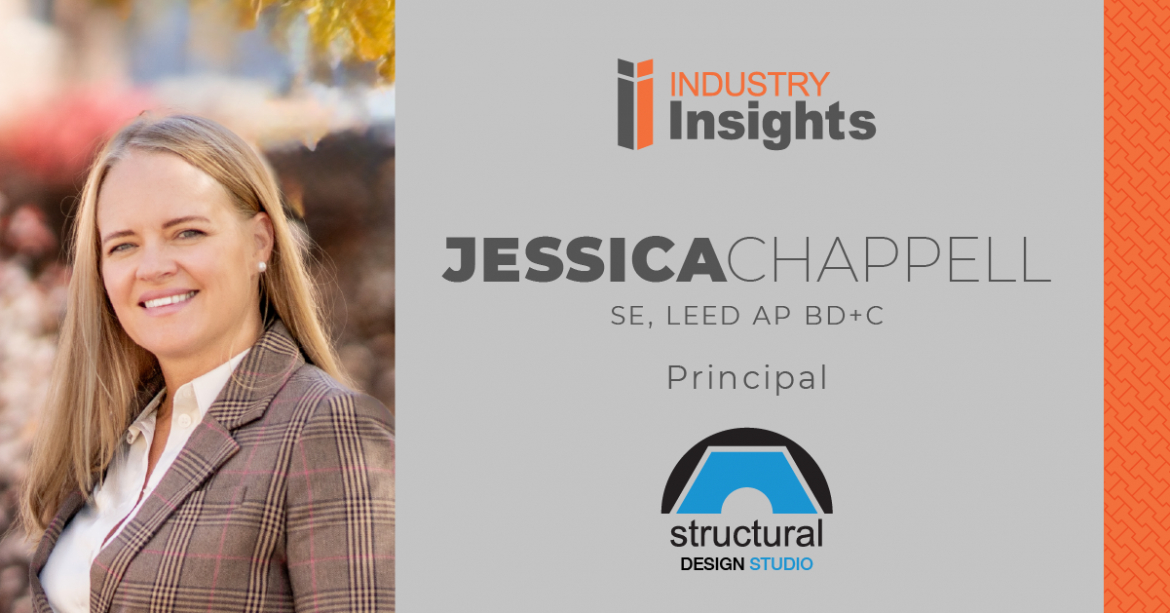

Jessica S. Chappell, SE, LEED AP BD+C | Principal | Structural Design Studio
Jessica Chappell built her career on complexity. As a Principal at Structural Design Studio, she leads work across some of the most varied project types in the Intermountain West: healthcare facilities, retail developments, children’s museums, and religious facilities. Each brings its own structural challenges, its own stakeholders, and its own definition of success.
No two days look the same. On any given day, Jessica might be writing a proposal in the morning, meeting with a prospective client at lunch, visiting a construction site in the afternoon, and finishing the evening reviewing structural calculations or developing a BIM model.
“That range is something I’ve come to appreciate,” she says. “It keeps the work honest, and it keeps me close to every stage of what we’re building.”
While safety is the foundation of every structural engineering project, Jessica sees a broader purpose behind the work: each design decision contributes to communities that will support people for decades. She actively seeks out conversations about seismic resilience and the long-term implications of today’s design choices, particularly in collaboration with other design professionals navigating the same questions.
Finding Opportunity in Complexity
Like many structural engineers, Jessica was drawn to the profession through math, science, and an early fascination with ambitious structures. What changed over time was her understanding of what the work actually requires.
“What I value most isn’t the analysis itself,” she says. “It’s the collaboration and problem-solving that turn a design into reality. An aggressive schedule, a floating stair, a complicated architectural feature—those are the moments I lean into. The constraints and complexities are where the interesting work happens.”
That orientation toward difficulty has served her across multiple environments: large consulting firms, design-build construction teams, and now Structural Design Studio’s smaller, highly collaborative setting. In each, she has found that the most satisfying projects are those that push diverse teams to work together toward a shared goal. There is something specific in how she describes it: the moment when a structural solution serves both the end user’s needs and the architect’s vision, and then you watch it take shape in a community and change it for the better.
Redefining Leadership
Jessica’s first Principal role centered on business development and mentoring early-career engineers, work she found meaningful but still bounded by a fairly traditional definition of what leadership looked like. A period in the design-build construction world changed that.
Working closely with architects, contractors, owners, and consultants exposed her to the distinct pressures each stakeholder carries into a project. That experience reshaped how she thinks about the role of a leader.
“I came to see leadership less as directing and more as understanding the team through the perspectives of the people around you, the weight of their roles, and the shared goal that holds the team together.”
That perspective has also shaped how she navigates a traditionally male-dominated field. She has found mentors and advocates among both men and women throughout her career. When she encountered unconscious bias, she treated those moments not as dead ends, but as opportunities to strengthen her ability to advocate for herself and move forward with greater confidence.
Creating Space for Future Leaders
When asked what qualities have carried her furthest, Jessica is direct: persistence, resilience, and a drive to improve. Engineering, she says, hands you a new opportunity to do better with every project. The teams that have energized her most are the ones where that standard is shared.
Her advice to women considering engineering reflects the same clarity. Technical knowledge matters, but she pushes back on the way the profession tends to undervalue everything else.
“The qualities often undersold in engineering school are the ones that matter most in practice: creative thinking, clear communication, and the ability to bring a team together. Those aren’t soft skills; they’re the work.”
As the industry marks Women in Engineering Day, Jessica is measured but clear-eyed about what the occasion means.
“To me, it’s a reminder that the work isn’t finished. Creating environments where women and men can thrive at every stage of their careers isn’t just the right thing to do; it’s a practical imperative. When we fail to retain that talent, we’re not just losing individuals. We’re leaving half the potential of our profession on the table. The best solutions come from the widest range of perspectives, and we can’t afford to keep narrowing the field.”
For someone who has spent her career leaning into the hard problems, that position comes naturally. The strongest structural solutions require the full range of forces to be understood and accounted for. Jessica Chappell believes the same is true of the profession itself.